AI BUYER PERSONA GUIDE
How to Create Buyer Personas With AI in 2026
AI can turn website and audience signals into structured buyer-persona hypotheses in minutes. The useful workflow is not to accept those personas as truth, but to review the goals, pain points, motivations and targeting ideas, validate them against real customers and use the strongest insights in campaign tests.
Disclosure: This page may contain affiliate links. We may earn a commission at no extra cost to you if you sign up through these links.
A buyer persona is useful only when it changes how you research, write, target and test. A profile with a name, age and stock photo is not enough. Useful personas connect customer goals, challenges, motivations, objections and preferred channels to real marketing decisions.
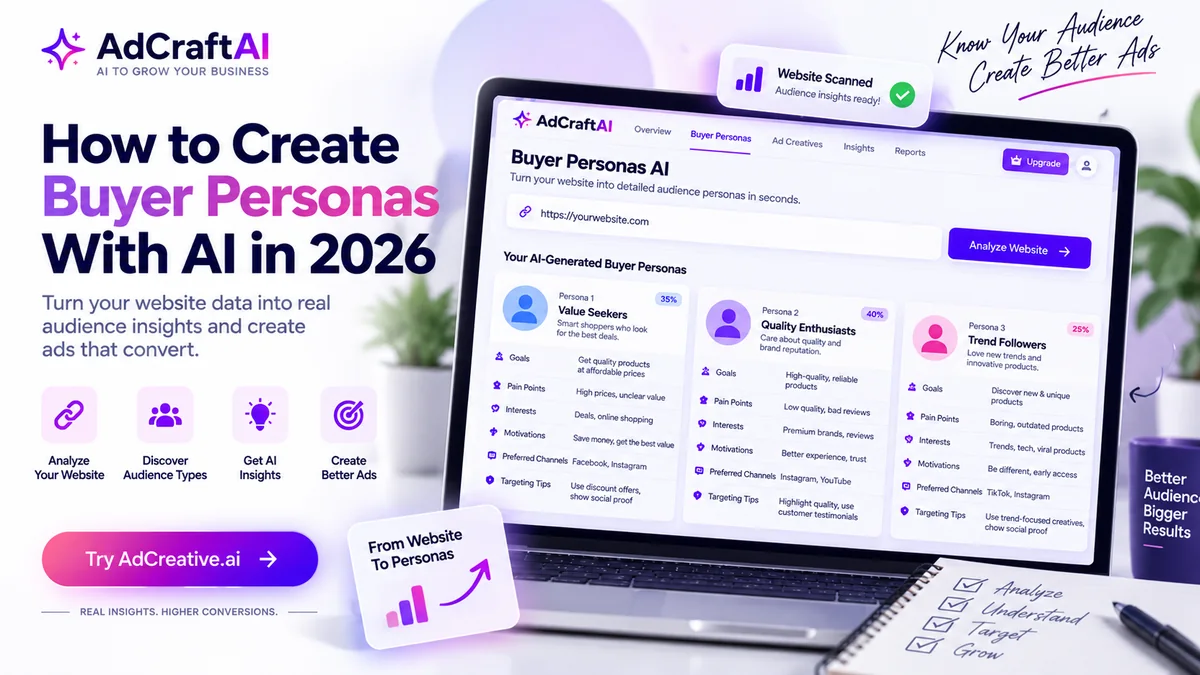
AI can speed up the first draft by organizing website content and audience signals into a structured profile. AdCreative.ai currently offers a Buyer Personas feature that scans a website and generates persona details, including interests, motivations and targeting ideas.
The output should be treated as a hypothesis until it is checked against your own analytics, customer interviews, CRM data, sales feedback and campaign performance.
If you want to research the market before building personas, read our competitor ad analysis guide . For the wider advertising workflow, see our complete AI advertising guide .
What Does Creating Buyer Personas With AI Actually Mean?
Creating buyer personas with AI means using software to turn available business and audience signals into structured customer profiles. The AI can help summarize patterns, organize audience characteristics and suggest messaging or targeting directions.
The result is not a verified customer record. It is a working marketing model that should become more accurate as you compare it with real customer evidence.
What Should a Useful Buyer Persona Include?
Useful personas are built around buying behavior, not decorative details. HubSpot's current persona guidance includes goals, challenges, communication preferences, information sources and real customer evidence. For advertising, keep the fields that can change a decision.
| Persona Field | Why It Matters |
|---|---|
| Goals | Shows what outcome the buyer is trying to achieve |
| Pain Points | Identifies the problem your message should address |
| Motivations | Explains why the buyer may take action |
| Objections | Shows what could stop the purchase |
| Interests | Can help with content and audience hypotheses |
| Preferred Channels | Suggests where the buyer may research or engage |
| Buying Context | Connects the persona to the real purchase situation |
What Data Should You Use Before Generating Buyer Personas?
AI output improves when you give it better evidence. A website is a useful starting point, but it should not be your only source.
- Website pages and product descriptions.
- Search terms and site analytics.
- CRM and sales notes.
- Customer interviews.
- Support tickets and common questions.
- Reviews and survey responses.
- Campaign and conversion data.
Important:
If your website itself is vague, the AI may create vague personas. Use the website-generated persona as a first hypothesis, then strengthen it with evidence from people who actually buy or evaluate your product.
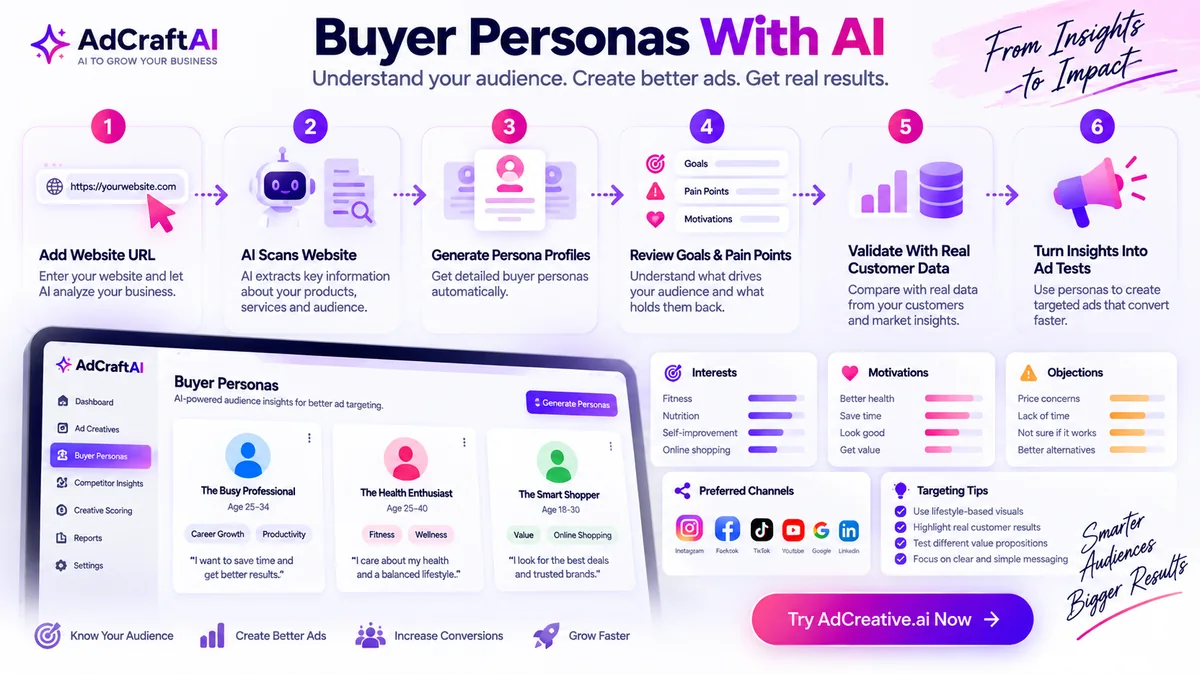
How to Create Buyer Personas With AI: Step by Step
1. Define the Marketing Decision First
Decide why you need the persona. Examples include improving paid-ad messaging, choosing a content angle, planning landing-page copy or separating audiences for testing.
2. Start With Your Website or Product Information
AdCreative.ai's current Buyer Personas page describes a website-scanning workflow. Enter the business website so the tool can use the site's products, positioning and audience context as a starting signal.
3. Generate More Than One Persona
Most businesses serve more than one buyer type. A useful persona set might separate:
- Value-focused buyers.
- Quality-focused buyers.
- Convenience-focused buyers.
- Professional or business buyers.
Do not force every customer into one generic profile.
4. Review Goals and Pain Points
These are usually the most useful fields for advertising. Ask whether the stated goal is something a real customer would recognize and whether the pain point is specific enough to write an ad around.
5. Review Motivations and Interests
Motivations should explain why someone might move from interest to action. Interests can support content and targeting hypotheses, but they should not be treated as verified facts without additional data.
6. Check Targeting Tips
AdCreative.ai's current Buyer Personas page shows targeting recommendations alongside generated persona details. Use them as campaign ideas, not as guaranteed audience definitions.
7. Add Missing Purchase Context
AI persona generators can produce broad demographic or interest information. Add the context that matters to the purchase:
- Trigger that starts the search.
- Alternative products being considered.
- Decision criteria.
- Main objection.
- Who else influences the decision.
- What proof is needed before buying.
8. Validate the Persona With Real Data
Compare the AI output with customer interviews, CRM patterns, analytics, sales conversations and actual campaign behavior.
9. Turn Each Persona Into a Different Message Test
A persona becomes useful when it changes the creative. Create different hooks, proof points, offers or CTAs for different audience hypotheses.
10. Update the Persona From Campaign Results
If one persona consistently responds to a different message than expected, update the persona. Real behavior should overrule an AI-generated assumption.
How AdCreative.ai Buyer Personas Work
AdCreative.ai currently positions Buyer Personas as an AI-powered audience-profiling tool. Its product page says the system scans a website and generates persona insights based on website data.
The current page highlights persona information such as demographics, behavior, interests, motivations and targeting tips. The goal is to help marketers understand likely audience segments and create more focused campaigns.
That can be useful for a fast first draft, especially when you need several audience hypotheses before writing ad creative.
Turn Website Signals Into Audience Hypotheses
Generate buyer-persona ideas, review goals, interests and motivations, then validate the strongest personas against your own customer data.
Discover the AI Tool →How to Validate AI-Generated Buyer Personas
Validation separates a useful persona from a plausible-looking profile. You do not need to prove every field, but you should verify the parts that affect real marketing decisions.
| Persona Claim | Validation Source |
|---|---|
| Main pain point | Interviews, support tickets, sales calls |
| Preferred channel | Analytics and campaign data |
| Main objection | Sales notes, lost deals, reviews |
| Motivation | Interviews, survey answers, conversion research |
| Offer preference | Controlled campaign tests |
Remove persona details that cannot be validated and do not change a marketing decision. More detail is not always better.
Turn Buyer Personas Into Better Ad Tests
Do not create three personas and then show all three the same advertisement. Each persona should lead to at least one meaningful test.
| Persona | Creative Direction |
|---|---|
| Value-focused | Price clarity, bundle value, savings or practical comparison |
| Quality-focused | Materials, proof, reviews, reliability and long-term value |
| Convenience-focused | Speed, simplicity, fewer steps and easy setup |
| Professional buyer | Efficiency, ROI, workflow and measurable business outcome |
After creating the variants, you can use our AI ad performance prediction workflow to compare creative candidates before launch.
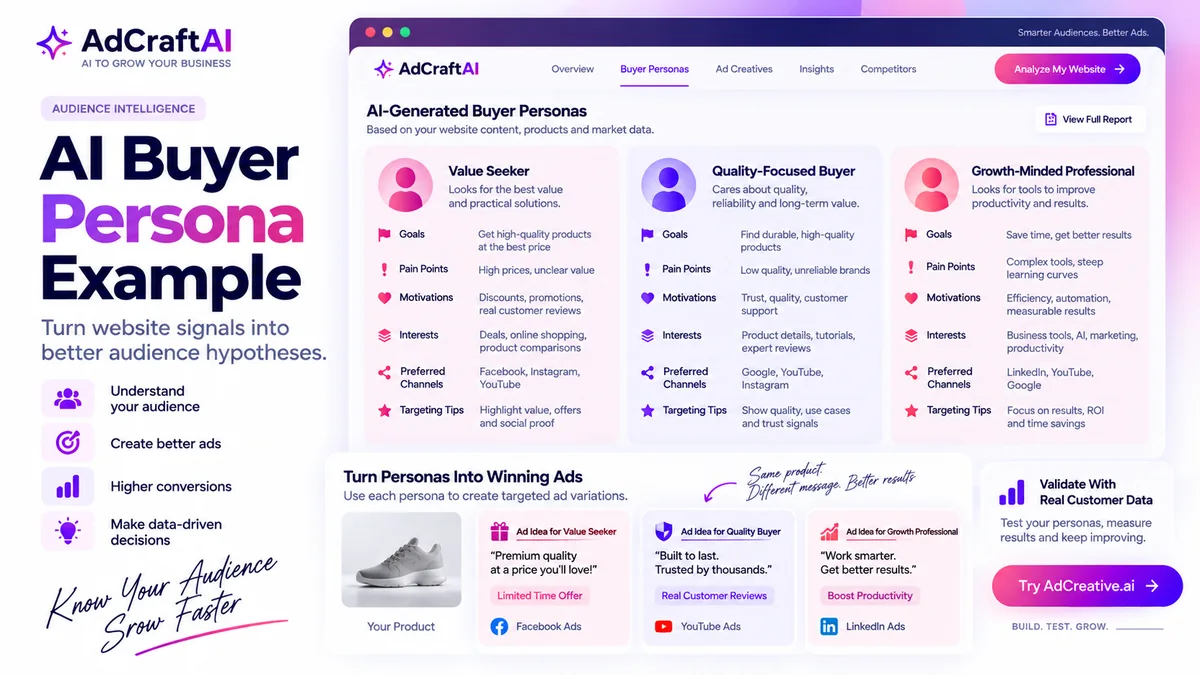
Practical Example: Create Buyer Personas for an Ecommerce Brand
Imagine we sell premium running shoes online. We scan the website and use AI to generate three starting personas.
Persona 1: Value Seeker
Goal: Buy reliable shoes without overpaying
Pain point: Premium products feel expensive
Motivation: Strong value for money
Test: Bundle, discount or cost-per-use message
Persona 2: Quality-Focused Runner
Goal: Find durable shoes for regular training
Pain point: Previous shoes wear out too quickly
Motivation: Reliability and product quality
Test: Materials, reviews and durability proof
Persona 3: Busy Professional
Goal: Stay active with a simple purchase decision
Pain point: Too many product choices
Motivation: Convenience and confidence
Test: Easy choice, fast delivery and simplified comparison
Validate Before Scaling
Now compare these assumptions with customer reviews, search behavior, support questions and campaign results. If the “Value Seeker” responds more strongly to quality proof than discounting, update the persona.
Common Mistakes When Creating Buyer Personas With AI
Treating the AI Output as Verified Research
AI can generate a plausible persona without proving that the profile represents a real customer segment.
Using Only Demographics
Age and location rarely explain why someone buys. Goals, problems, motivations and decision criteria are usually more useful.
Creating Too Many Personas
If every small difference creates a new persona, the framework becomes difficult to use. Start with a few meaningful segments.
Adding Details That Never Affect a Decision
A persona does not need a favorite coffee, fictional biography or decorative lifestyle details unless those details affect marketing.
Never Updating the Persona
Personas should evolve when your product, customer mix, market or campaign data changes.
Creating Personas Without Campaign Activation
If the persona does not change a message, offer, landing page or audience test, it is probably too abstract.
A Simple AI Buyer Persona Workflow
- Define the marketing decision the persona should support.
- Gather website, product and customer evidence.
- Generate several persona hypotheses with AI.
- Review goals, pain points and motivations.
- Review interests and targeting suggestions.
- Add purchase context and objections.
- Remove irrelevant or unsupported details.
- Validate important claims with real customer data.
- Create different ad messages for different personas.
- Launch controlled campaign tests.
- Compare actual behavior with the persona assumptions.
- Update the personas based on what you learn.
Complete the AdCreative Service Workflow
Frequently Asked Questions About AI Buyer Personas
Can AI create buyer personas?
Yes. AI can organize website and audience information into structured persona hypotheses containing fields such as goals, pain points, interests and motivations.
What is AdCreative.ai Buyer Personas?
It is AdCreative.ai's AI-powered audience-profiling feature. The current product page says it scans a website and generates detailed buyer-persona insights and targeting suggestions.
Can AdCreative.ai generate personas from a website?
Yes. AdCreative.ai currently describes a website-scanning workflow that uses website information to generate persona details.
What should a buyer persona include?
Useful fields include goals, challenges, motivations, objections, preferred channels, buying context and the information needed to make a decision.
Are AI-generated buyer personas accurate?
They can be useful starting hypotheses, but they should be validated against real customer research, analytics, CRM data and campaign behavior.
Can I use buyer personas for ad targeting?
Yes, as a starting framework. Use persona interests, problems and channels to form targeting hypotheses, then validate those hypotheses through real campaign results.
How many buyer personas should I create?
Start with a small number of meaningfully different buyer types. Add another persona only when it changes an important marketing decision.
Should AI replace customer interviews?
No. AI can accelerate organization and drafting, while interviews and real customer behavior provide evidence that the persona actually reflects the market.
How do I know if a buyer persona is useful?
A useful persona changes what you test: the hook, offer, proof point, channel, landing page or CTA. If nothing changes, the persona is probably too generic.
Buyer Persona Resources
Final Thoughts
AI makes buyer-persona creation faster, but speed is not the same as accuracy. Use AI to turn scattered signals into a clear first draft. Then validate the parts that influence real marketing decisions.
The strongest persona is not the most detailed profile. It is the profile that helps you write a better message, design a better test and learn something useful from real customer behavior.
Create Buyer Personas With AI
Scan your website, generate audience hypotheses and turn persona insights into more focused advertising tests.
Discover the AI Tool →