COMPETITOR INSIGHTS AI GUIDE
How to Analyze Competitor Ads With AI in 2026
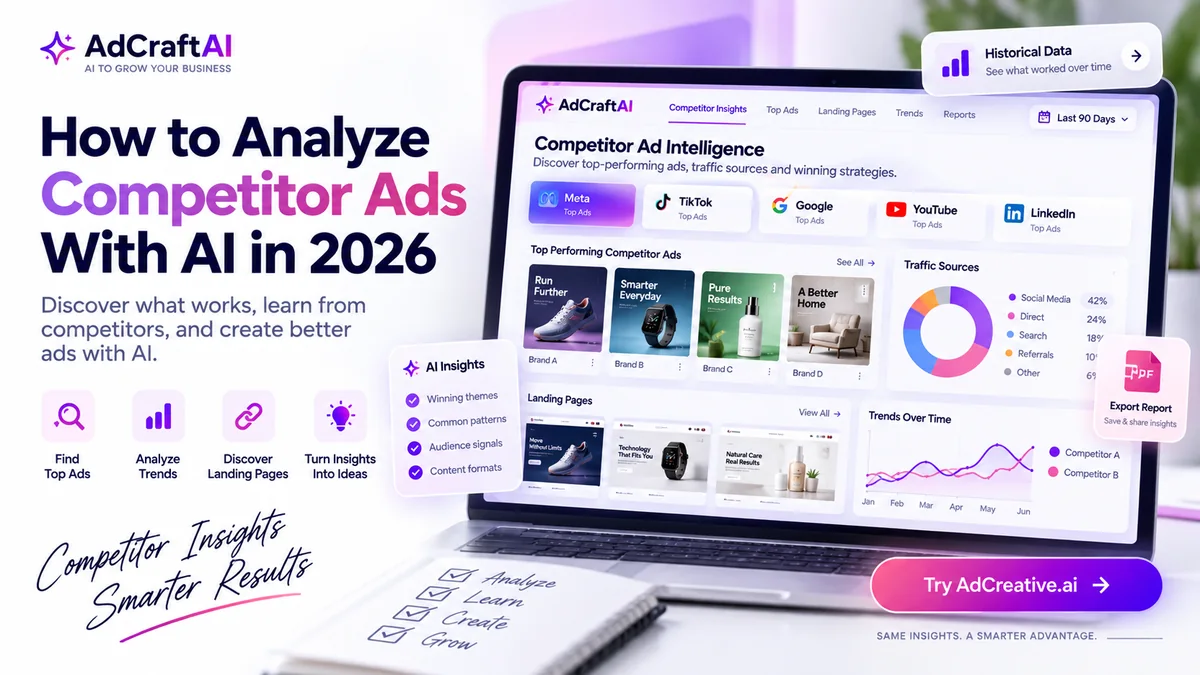
AI competitor research can help you move beyond randomly browsing ad libraries. The useful workflow is to identify the right competitors, review their active creative, study traffic and landing-page signals, group recurring patterns and turn those patterns into your own tests.
Disclosure: This page may contain affiliate links. We may earn a commission at no extra cost to you if you sign up through these links.
Competitor ad analysis should answer a business question. It is not about copying another brand's headline, design or offer. The goal is to identify patterns: which hooks appear repeatedly, which products receive the most promotion, which landing pages are used, which traffic channels matter and which creative directions are worth testing in your own account.
Public ad libraries such as Meta Ad Library and Google's Ads Transparency Center are useful places to inspect live advertising. They show what brands are running, but public libraries do not automatically reveal exact ROAS, conversion rate or profit.
AdCreative.ai's Competitor Insights AI adds another layer by organizing competitor creative, traffic estimates, locations, landing pages and historical trend views into one research workflow.
If you want to score your own creatives after research, read our guide to predicting ad performance with AI . For the broader strategy, see our complete AI advertising guide .
What Does Analyzing Competitor Ads With AI Actually Mean?
AI competitor ad analysis means using software to organize large amounts of competitor data and summarize patterns that would take longer to find manually.
Useful outputs can include:
- Common hooks and message angles.
- Frequently used ad formats.
- Products or offers promoted repeatedly.
- Landing pages used behind the ads.
- Estimated traffic sources and visitor patterns.
- Changes over a selected time period.
- Creative ideas worth testing for your own brand.
What Should You Analyze in Competitor Ads?
Do not start with “Which ad looks best?” Analyze repeatable elements that can inform your own creative strategy.
| Signal | What to Look For |
|---|---|
| Hook | Problem-first, benefit-first, curiosity, demo or offer |
| Format | Static image, short video, product demo, UGC or carousel |
| Offer | Discounts, bundles, free trials, free shipping or demos |
| CTA | Shop Now, Learn More, Book Demo, Start Free or other action |
| Visual Style | Studio product, lifestyle, text-led, creator-led or comparison |
| Landing Page | Homepage, product page, collection page or campaign landing page |
| Longevity | Whether a creative or angle continues appearing over time |
Useful Data Sources for Competitor Ad Research
A strong workflow can combine public ad libraries with AI-powered competitor intelligence.
Meta Ad Library
Meta Ad Library lets you search currently running ads across Meta technologies by advertiser or keyword. It is useful for seeing live creative, copy, format and campaign longevity. For normal commercial ads, do not treat the library as a source of exact spend or ROAS.
Google Ads Transparency Center
Google's Ads Transparency Center lets you search active ads by advertiser name or website and inspect ads that have been published through Google.
AI Competitor Intelligence
Third-party tools can organize public and estimated signals into a more convenient research view. AdCreative.ai's Competitor Insights AI currently advertises competitor creative discovery, traffic and visitor estimates, top channels and locations, landing-page discovery, reports and historical analysis.
Important:
Separate observed data from estimated data. A visible ad creative is directly observable. Traffic, demographic and visitor metrics may be modeled or estimated by the tool.
How to Analyze Competitor Ads With AI: Step by Step
1. Start With a Decision
Define the question before collecting ads. Examples:
- Which hooks are common in this category?
- Which offers appear repeatedly?
- Which ad formats do competitors rely on most?
- Which landing-page types support their campaigns?
- Which creative gaps could we test?
2. Choose the Right Competitors
Include direct competitors, but do not stop there. A useful research set can include:
- Two direct competitors.
- One larger category leader.
- One smaller or fast-growing brand.
- One adjacent brand with a similar audience.
3. Add Competitor Website URLs
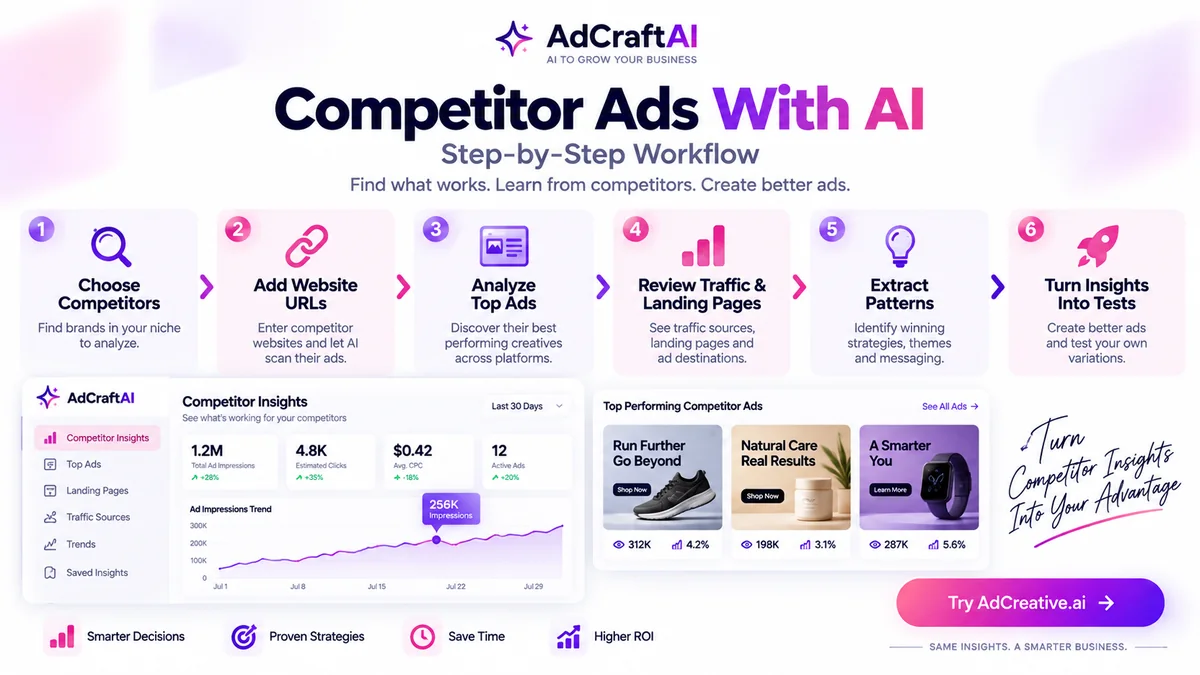
AdCreative.ai's current help documentation describes the Competitor Insights workflow as starting with a competitor website URL. The system can also suggest companies to track based on your business.
4. Review the Ad Overview Before Individual Creatives
Start broad. Look for the platforms, traffic signals, landing pages and time trends before zooming in on a single advertisement.
5. Study the Competitor's Repeated Ad Patterns
One ad can be an experiment. A pattern across many ads is more useful.
Group creatives by:
- Hook
- Offer
- Format
- Product
- Audience problem
- CTA
6. Compare Landing Pages With the Ad Message
The click destination often explains what the ad is trying to accomplish. A product ad that lands on a dedicated product page is a different strategy from a broad brand ad that sends users to the homepage.
7. Review Traffic Sources and Locations
Competitor Insights AI currently presents visitor and traffic-source estimates, including top channels, locations and landing-page information. Use these signals as directional research, not exact internal analytics from the competitor.
8. Change the Time Range
AdCreative.ai currently advertises historical competitor analysis with a date picker and access to periods up to one year in the past.
This helps separate a temporary promotion from a recurring strategy.
9. Export or Save the Research
AdCreative.ai's help center says Competitor Insights can be exported as a PDF. Save reports when you need to compare competitors over time or share findings with a team.
10. Turn Research Into Three Testable Ideas
Do not end with a report. Convert the research into a small creative test plan.
Example:
If several competitors repeatedly use problem-first hooks, short product demos and a free-shipping offer, do not copy their exact ads. Build your own three tests: one problem-first, one demo-first and one offer-first creative.
How AdCreative.ai Competitor Insights AI Works
AdCreative.ai positions Competitor Insights AI as an ad-intelligence workflow for discovering competitor creative and understanding broader acquisition patterns.
The current product page highlights:
- Competitor ad creative discovery across platforms.
- Visitor-count estimates.
- Traffic-channel and location insights.
- Landing-page discovery.
- Historical date-range analysis.
- Downloadable reports.
Its help center also describes a simple URL-based workflow: add a competitor website, request the insight, adjust the date range and review the detailed results.
Turn Competitor Research Into Better Test Ideas
Use one workspace to review competitor ads, traffic and landing-page signals, then turn recurring patterns into your own creative experiments.
Discover the AI Tool →How to Read “Top Competitor Ads” Without Overclaiming
Ad intelligence tools often label certain competitor ads as top-performing. Treat that ranking as a tool-generated signal, not direct access to a competitor's private ad account.
The safest way to use the ranking is to study repeated creative characteristics:
- Which products appear most often?
- Which hooks repeat?
- Which formats dominate?
- Which offers appear across several creatives?
- Which landing pages receive repeated promotion?
The more a pattern repeats across creative, platform and time, the more useful it becomes as a research signal.
Use Traffic Sources and Landing Pages to Understand Strategy
Creative alone tells only part of the story. Traffic channels and landing pages can help you understand how a competitor connects advertising to the rest of its funnel.
| Signal | Question to Ask |
|---|---|
| Top traffic channel | Where does the brand appear to rely most heavily on acquisition? |
| Landing page | Does the campaign use a product, collection or dedicated offer page? |
| Location | Which markets appear important to the brand? |
| Time trend | Is the strategy persistent or seasonal? |
Turn Competitor Patterns Into Original Creative Tests
The goal is not imitation. Use the research to identify what the market is already saying and where you can test a different angle.
Example Pattern
Suppose three competitors consistently use discount-led static ads.
That does not automatically mean your brand should run another discount ad. A better test might be a product-demo creative, a proof-led creative or a stronger problem-solution angle.
Practical Example: Analyze Three Competitors With AI
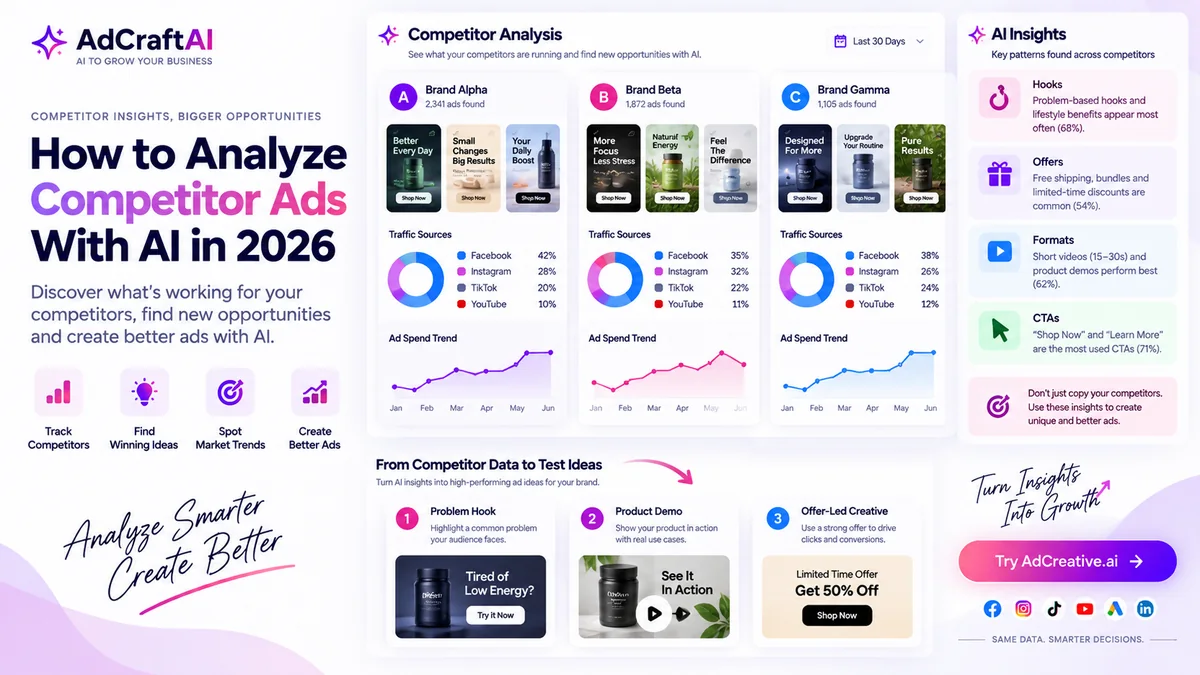
Imagine we sell a premium skincare product. We choose three direct competitors and review their recent advertising.
Competitor A
Repeated angle: Problem-solution
Format: Short video
Offer: Free shipping
Landing page: Product page
Competitor B
Repeated angle: Ingredient education
Format: Static product image
Offer: Bundle
Landing page: Collection page
Competitor C
Repeated angle: Lifestyle / routine
Format: UGC-style video
Offer: No visible discount
Landing page: Dedicated campaign page
Turn the Research Into Tests
Instead of copying any single competitor, we build three original hypotheses:
- Problem-first product demo.
- Ingredient education with a stronger visual proof point.
- Lifestyle routine creative with no discount dependency.
Those become our own ads, written for our product, our audience and our brand voice.
Common Mistakes When Analyzing Competitor Ads With AI
Copying a Single Ad
One creative may be an experiment. Look for repeated patterns across several ads and time periods.
Treating Estimated Data as Exact Analytics
Visitor counts, demographics and traffic-source data from third-party tools can be estimates. Use them directionally.
Assuming “Top Ad” Means Known ROAS
Unless a tool has direct private account access, do not assume it knows a competitor's exact profitability.
Researching Too Many Competitors
Ten shallow competitor reports can be less useful than four focused comparisons.
Ignoring the Landing Page
The creative and destination are part of the same funnel. Review them together.
Finishing With Insights Instead of Tests
A report has no value if it does not change what you test next.
A Simple AI Competitor Ad Analysis Workflow
- Define one research question.
- Choose three to five relevant competitors.
- Add competitor website URLs.
- Review current ads and platform mix.
- Group recurring hooks, offers and formats.
- Review traffic and landing-page signals.
- Compare different date ranges.
- Separate observed data from estimated data.
- Identify gaps or overused angles.
- Convert findings into three creative hypotheses.
- Create original ads from those hypotheses.
- Score and test the new creatives with your own data.
Continue Building Your AI Advertising Workflow
Frequently Asked Questions About AI Competitor Ad Analysis
Can AI analyze competitor ads?
Yes. AI can help organize competitor creative, identify repeated hooks, offers and formats, and summarize broader patterns. The usefulness depends on the quality and coverage of the underlying data.
What is AdCreative.ai Competitor Insights AI?
It is AdCreative.ai's competitor research feature for reviewing competitor ads together with traffic, location, landing-page and historical trend insights.
Can I analyze a competitor by website URL?
Yes. AdCreative.ai's help documentation describes a workflow where you enter a competitor's website URL and request competitor insights.
Does Competitor Insights show traffic sources?
AdCreative.ai's current product page says the feature can estimate top traffic channels, visitor data, locations and landing pages.
Can I view historical competitor data?
AdCreative.ai currently advertises a date picker for historical analysis with access to periods up to one year in the past.
Can I export competitor insights?
Yes. AdCreative.ai's help center says competitor insights can be exported as a PDF report.
Is Meta Ad Library enough for competitor analysis?
Meta Ad Library is useful for inspecting live Meta creative and campaign longevity. Broader competitor analysis may also require landing pages, traffic context, other advertising platforms and historical tracking.
Can I see a competitor's exact ROAS?
Not from public ad libraries alone. Exact profitability, conversion economics and internal attribution are generally private. Treat third-party performance labels as research signals, not guaranteed access to private account metrics.
Should I copy competitor ads that appear successful?
No. Use competitor analysis to understand patterns and gaps, then create original advertising for your own product, audience and brand.
Competitor Ad Research Resources
Final Thoughts
The best competitor research does not end with a gallery of ads. It ends with a clearer idea of what the market is doing and what your brand should test next.
Use AI to organize the data, find recurring patterns and shorten the research process. Keep the strategic decision human: which insight matters, which gap is worth testing and how to create something original.
Analyze Competitor Ads With AI
Review competitor creative, traffic and landing-page signals, compare historical patterns and turn the strongest insights into your own advertising tests.
Discover the AI Tool →