AI AD PERFORMANCE GUIDE
How to Analyze Your Ad Performance With AI in 2026
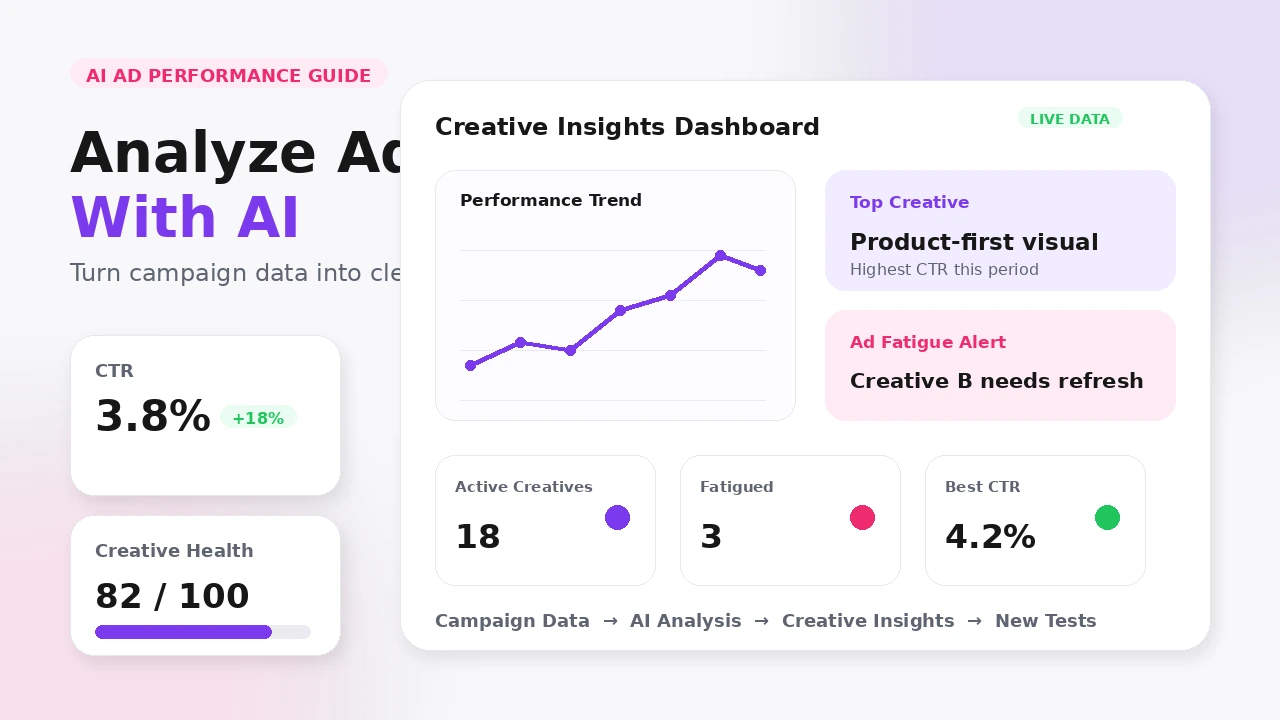
Running ads generates a large amount of performance data, but numbers alone do not tell you which creative decisions should be repeated, changed or stopped. AI can help organize campaign data, identify stronger creatives, detect signs of ad fatigue and turn performance patterns into clearer creative decisions.
Disclosure: This page may contain affiliate links. We may earn a commission at no extra cost to you if you sign up through these links.
Advertising optimization often starts with metrics such as click-through rate, conversions, cost, frequency and return on ad spend. But creative analysis asks a different question: what is happening inside the ads that may explain those results?
AI-assisted creative analysis can help marketers compare advertising assets, find repeated characteristics among stronger ads, identify weaker or fatigued creatives and decide what should be tested next.
This is different from trying to evaluate a creative before the campaign launches. If you want a pre-launch workflow, read our guide to predicting ad performance with AI . This guide focuses on analyzing creatives after real advertising data starts accumulating.
What Does Analyzing Ad Performance With AI Mean?
Analyzing ad performance with AI means using machine-assisted analysis to organize campaign results and connect performance data with creative characteristics.
Instead of looking only at a spreadsheet of campaigns, you can examine questions such as:
- Which creatives are generating stronger results?
- Which ad texts appear among the better-performing ads?
- Are previously strong creatives beginning to decline?
- Are users seeing the same creative too often?
- Which creative direction should be refreshed?
- What should be tested in the next creative batch?
What Advertising Data Should You Analyze?
AI does not eliminate the need to understand basic advertising metrics. The useful approach is to combine performance data with the creative that produced it.
| Metric | What It Can Help You Understand |
|---|---|
| Impressions | How much exposure a creative received |
| Click-Through Rate | How often impressions turned into clicks |
| Frequency | How repeatedly an audience may be seeing the same ad |
| Conversion Data | Whether traffic produced the intended campaign action |
| Cost Data | How efficiently results are being produced |
| Creative Age | Whether performance changes as an ad continues running |
No individual metric explains the entire result. For example, a high click-through rate does not automatically mean the campaign is profitable. Creative analysis should be interpreted together with the campaign objective, audience, offer and conversion data.
How to Analyze Ad Performance With AI: Step by Step
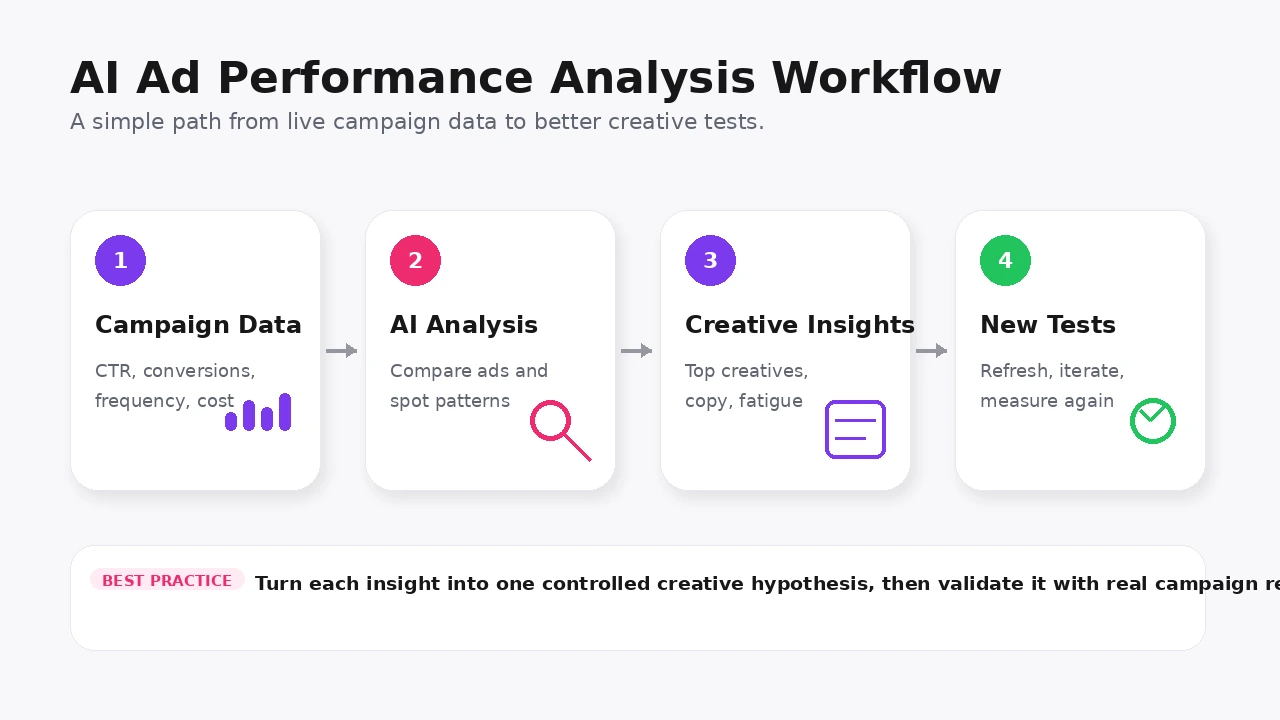
1. Define the Decision You Need to Make
Start with a clear question. Do you want to identify the strongest creative, replace a fatigued ad, improve the next creative batch or understand why one concept performs differently from another?
2. Connect or Import Relevant Campaign Data
Use data from campaigns that are comparable. Avoid mixing unrelated audiences, objectives, offers and markets when you are trying to understand creative differences.
3. Compare Creatives Under Similar Conditions
If possible, compare ads serving the same objective and similar audience. Otherwise, a performance difference may come from campaign setup rather than the creative itself.
4. Identify the Strongest Creatives and Texts
Look for creatives that repeatedly appear near the top of your selected performance metrics. Then inspect their visual structure, headline, offer, call to action and opening message.
5. Look for Signs of Creative Fatigue
A creative can perform well early and weaken after repeated exposure. AI monitoring can help surface those changes so you can decide whether the ad needs a refresh.
6. Separate Patterns From One-Off Results
One successful ad does not prove that every element inside it caused the success. Look across several creatives and multiple time periods before turning an observation into a new creative rule.
7. Convert Findings Into Specific Tests
The final output of analysis should be a testable creative idea. Instead of saying: “Bright ads perform better.” create a more specific hypothesis such as:
Keep the same offer and headline, but compare the current dark background against a brighter high-contrast variation.
8. Measure the New Version
Publish the new creative under controlled conditions and compare its results with the previous version. The campaign data should validate whether the insight was actually useful.
How AdCreative.ai Creative Insights Works
AdCreative.ai currently positions Creative Insights AI as a tool for analyzing creative performance after connecting advertising accounts.
According to the platform's current product information, Creative Insights can help users identify top-performing creatives, evaluate effective ad texts and monitor creative fatigue.
The platform also presents creative-refresh recommendations when it identifies underperforming or fatigued ads.
AdCreative.ai currently lists integrations including Meta Ads, Google Ads, LinkedIn Ads, Pinterest Ads and Microsoft Ads. Platform support can change, so confirm the current integrations before connecting your workflow.
Analyze Your Existing Ad Creatives
Creative Insights AI can connect campaign data with creative-level analysis to help identify stronger ads, fatigue signals and new creative opportunities.
Explore Creative Insights →How to Identify Your Top-Performing Ad Creatives
Start by defining what top-performing means for the specific campaign. A traffic campaign, lead-generation campaign and ecommerce conversion campaign should not necessarily use the same success metric.
| Goal | Useful Signals |
|---|---|
| Traffic | CTR, clicks and cost per click |
| Leads | Lead volume, conversion rate and cost per lead |
| Ecommerce Sales | Purchases, conversion rate, cost per acquisition and revenue |
| Awareness | Reach, impressions and other campaign-specific awareness signals |
Once you know which creatives are strongest, inspect what they have in common.
- Product position
- Background and dominant colors
- Headline structure
- Offer
- Call to action
- Amount of text
- Image or video format
- Opening hook
How to Detect Ad Fatigue With AI
Ad fatigue happens when continued exposure to the same advertising creative is associated with weaker audience response.
It should not be diagnosed from one metric in isolation. Review several signals together and compare them over time.
| Possible Signal | What to Check |
|---|---|
| CTR declining | Is audience response weakening over time? |
| Frequency increasing | Are the same users repeatedly seeing the creative? |
| Cost increasing | Is the ad becoming less efficient? |
| Conversions declining | Has downstream campaign performance weakened too? |
AdCreative.ai says its Creative Insights AI monitors ad accounts for signs of fatigue and can recommend when creatives should be updated.
Important:
A declining ad does not automatically mean the creative is the only problem. Audience saturation, competition, seasonality, budget changes, landing pages and offers can also affect results.
What Is the Creative Insight Score?
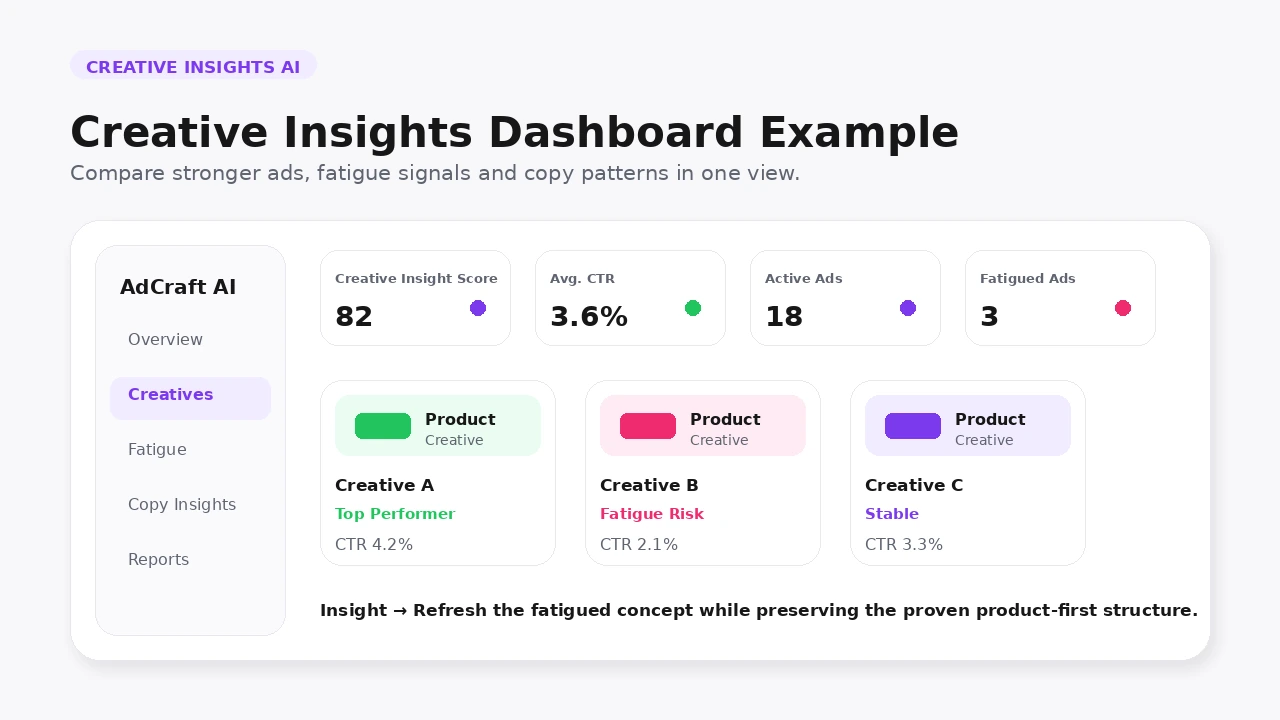
AdCreative.ai currently describes its Creative Insight Score as a benchmarking metric for comparing creative performance against the advertiser's market.
According to the platform, the score combines three main inputs:
- Average click-through rate
- Number of active ad creatives
- Proportion of fatigued ad creatives
The purpose of the score is to give marketers a summarized comparison, but it should still be interpreted alongside the underlying campaign metrics and business results.
How to Analyze Ad Copy Performance With AI
Creative analysis should include more than the image or video. The headline, primary text, offer and call to action may also influence how users respond.
Compare recurring copy patterns among stronger and weaker ads.
| Copy Element | Question to Ask |
|---|---|
| Hook | What gets attention in the opening line? |
| Benefit | Is the main customer benefit immediately clear? |
| Offer | Is the offer specific and easy to understand? |
| Social Proof | Do stronger ads use reviews, proof or credibility signals? |
| CTA | Is the requested next action clear? |
Avoid assuming that one phrase caused the entire performance difference. Use the analysis to create controlled copy tests.
How to Turn Performance Insights Into New Ad Creatives
Analysis is useful only when it changes what you create next.
Suppose your stronger creatives share three characteristics:
- The product appears immediately
- The headline focuses on one clear benefit
- The visual uses a simple high-contrast background
Do not simply duplicate the winning ad. Instead, preserve the hypothesis while creating a fresh variation.
Keep the same product-first structure and core benefit, but test a new layout, a new background and a different visual hierarchy.
If you need new product-based creative assets, continue with our AI product photography guide or our AI product video guide .
Practical Example: Analyze Three Ecommerce Ads
Imagine an ecommerce brand is running three ads for the same product, audience and campaign objective.
| Creative | Observation | Next Test |
|---|---|---|
| Ad A | Strong CTR and stable performance | Preserve the core visual structure |
| Ad B | Started strongly but performance is declining | Refresh the design while keeping the proven message |
| Ad C | Weak response from the beginning | Test a different hook or creative concept |
The goal is not to label one ad as universally good and another as universally bad. The goal is to use the available campaign evidence to decide what creative test should happen next.
Combine Your Own Performance Data With Competitor Research
Your own campaign data should remain the primary source for understanding what works with your audience. Competitor research can provide additional context for new hooks, offers and creative formats.
For that workflow, read our guide to analyzing competitor ads with AI .
You can also use customer and audience insights to improve the relevance of your next creative batch. See our guide to creating buyer personas with AI .
Common Mistakes When Analyzing Ad Performance With AI
Looking at CTR Alone
CTR can help explain engagement, but it does not represent the complete business outcome.
Comparing Unrelated Campaigns
Different audiences, objectives, placements and offers can make creative comparisons misleading.
Assuming Correlation Means Cause
If several strong ads use the same color, that does not prove the color caused the performance. Turn the observation into a controlled test.
Refreshing Every Ad Too Quickly
Do not replace a creative simply because one short time period looks weaker. Review enough campaign context before making the change.
Ignoring Landing-Page Performance
A strong ad can generate clicks while the landing page fails to convert them. Analyze the complete customer journey.
Copying Competitors Instead of Learning From Patterns
Competitor data should help create hypotheses. Your own campaign performance should determine what works for your audience.
A Simple AI Ad Performance Analysis Workflow
- Define the campaign objective.
- Choose comparable ads.
- Review impressions and delivery.
- Compare CTR and other relevant performance metrics.
- Identify stronger creatives and copy.
- Check for fatigue and declining performance.
- Look for repeated creative patterns.
- Separate observations from assumptions.
- Create one specific creative hypothesis.
- Produce a controlled variation.
- Launch the new test.
- Validate the insight with real campaign results.
Continue Building Your AI Advertising Workflow
Frequently Asked Questions About AI Ad Performance Analysis
Can AI analyze ad performance?
Yes. AI can help organize advertising data, identify performance patterns, compare creatives and surface potential optimization opportunities. Final decisions should still consider campaign context and business results.
What is Creative Insights AI?
Creative Insights AI is an AdCreative.ai feature designed to analyze connected advertising accounts and provide creative-level insights such as top-performing creatives, effective ad texts and fatigue signals.
What is ad fatigue?
Ad fatigue describes a situation where an advertising creative begins receiving weaker audience response after repeated exposure. It should be evaluated using multiple campaign signals rather than one metric alone.
What is the Creative Insight Score?
AdCreative.ai describes the Creative Insight Score as a market benchmarking metric that incorporates average CTR, active creative count and the proportion of fatigued creatives.
Is analyzing ad performance the same as predicting ad performance?
No. Performance prediction evaluates creatives before or around launch using predictive signals. Performance analysis uses actual campaign data to understand what happened and guide the next creative decision.
Should I replace an ad as soon as CTR drops?
Not automatically. Review the campaign objective, frequency, conversion data, costs, audience conditions and the length of the comparison period before deciding whether the creative needs to be replaced.
Can AI tell me exactly why an ad performed well?
AI can identify patterns and generate useful hypotheses, but campaign performance can be influenced by many factors. Controlled testing is still needed to determine whether a specific creative change actually improves results.
Creative Insights Resources
Advertising platforms and AI features can change over time. Check the official product information before building a permanent workflow around specific integrations or features.
Final Thoughts
The biggest benefit of AI ad performance analysis is not another dashboard. It is the ability to turn campaign data into clearer creative questions.
Identify what is working, watch for fatigue, compare patterns carefully and convert each useful observation into a controlled creative test.
Then use real campaign results to decide whether the new direction deserves further investment.
Analyze Your Ad Creatives With AI
Connect campaign performance with creative insights to identify stronger ads, monitor fatigue and find new creative testing opportunities.
AdCreative.ai includes Creative Insights AI alongside creative generation, competitor analysis and predictive scoring tools.
Discover the AI Tool →