AI AD COPY GUIDE
How to Write Ad Copy With AI in 2026
Turn a product, offer or website into multiple ad-copy angles, then refine and test the strongest variations.
Disclosure: This page may contain affiliate links. We may earn a commission at no extra cost to you if you sign up through these links.
Writing ad copy with AI means using a language model to turn campaign inputs—such as a product, offer, audience, landing page or website URL—into advertising text. The useful part is not simply generating more words. It is creating several clear messaging angles that can be reviewed, edited and tested.
AI is most useful here as a production and decision-support tool. It can speed up repetitive work and create more options, but the final creative still needs human review, accurate source information and real campaign testing.
For the wider process, see our complete AI advertising guide.
What Does Ad Copy Generation Mean in Practice?
Writing ad copy with AI means using a language model to turn campaign inputs—such as a product, offer, audience, landing page or website URL—into advertising text. The useful part is not simply generating more words. It is creating several clear messaging angles that can be reviewed, edited and tested.
The objective is a repeatable creative workflow. Better inputs create better drafts, careful review reduces avoidable mistakes, and live performance data tells you what deserves another iteration.
What Inputs Matter Most?
| Input | Why It Matters |
|---|---|
| Product or service | Tells the AI what the ad is actually selling. |
| Audience | Helps shape language, objections and benefit emphasis. |
| Offer | Gives the copy a concrete reason to act. |
| Campaign objective | Keeps the message aligned with traffic, leads or sales. |
| Tone of voice | Helps match brand personality and platform context. |
| Website URL | Can provide product details, value propositions and messaging angles. |
What to Prepare Before You Start
- Choose one product, service or offer for the ad.
- Define the primary audience before generating copy.
- Write down the strongest benefit in plain language.
- Confirm price, discount and promotional details.
- Decide which advertising platform the copy is for.
- Collect any claims that require extra review before publishing.
Rule of thumb: If an important fact is unclear before generation, AI usually does not make that uncertainty disappear. Fix the source input first.
How to Write Ad Copy With AI: Step by Step
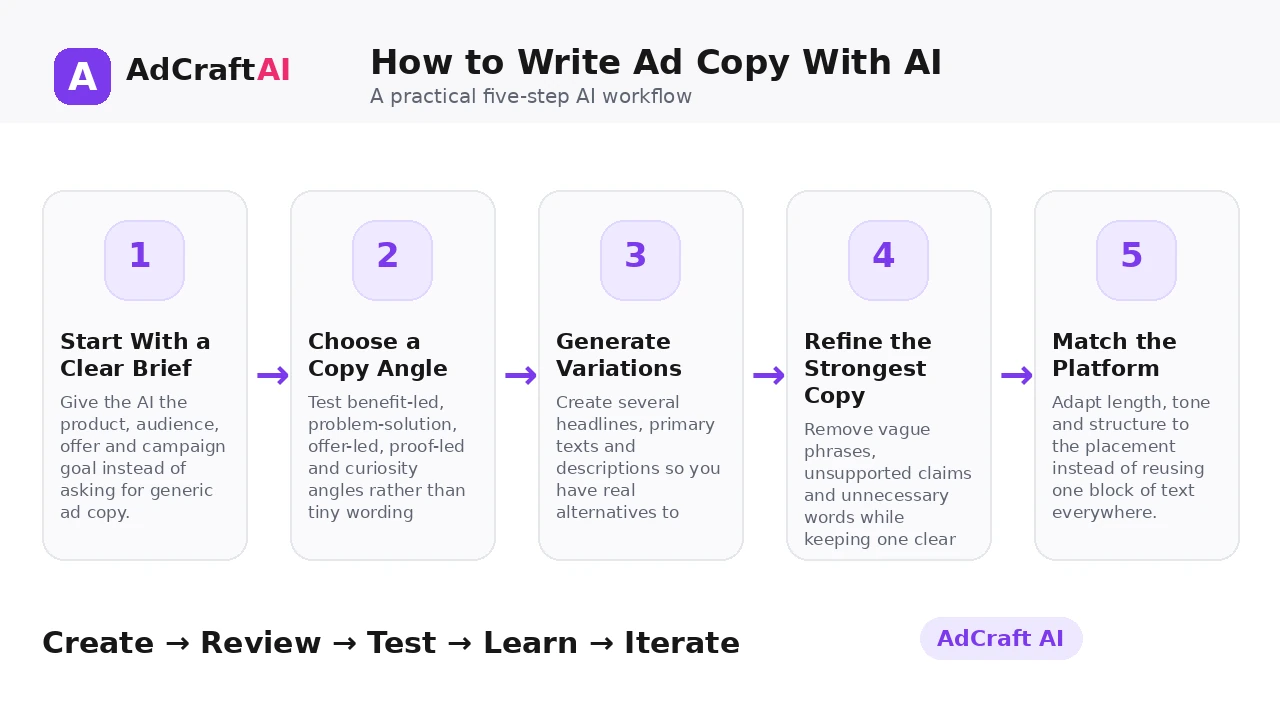
1. Start With a Clear Brief
Give the AI the product, audience, offer and campaign goal instead of asking for generic ad copy.
2. Choose a Copy Angle
Test benefit-led, problem-solution, offer-led, proof-led and curiosity angles rather than tiny wording changes.
3. Generate Variations
Create several headlines, primary texts and descriptions so you have real alternatives to compare.
4. Refine the Strongest Copy
Remove vague phrases, unsupported claims and unnecessary words while keeping one clear promise.
5. Match the Platform
Adapt length, tone and structure to the placement instead of reusing one block of text everywhere.
6. Score and Review
Use pre-launch scoring as a prioritization signal, not as a guarantee of future campaign results.
7. Run a Controlled Test
Compare meaningfully different messages under similar campaign conditions.
8. Use Live Results
Let CTR, conversion rate and downstream results guide the next copy iteration.
How AdCreative.ai Ad Copy Generation Works
AdCreative.ai currently describes its Ad Copy Generator as a tool for creating headlines, primary text and descriptions for Meta, Google and display campaigns. Its product page also lists AIDA and PAS-style copy frameworks, tone and language controls, website-URL input and built-in Creative Scoring AI.
The useful workflow is to treat those outputs as drafts. Generate multiple angles, edit the strongest versions, verify claims and then test the copy with real campaign data.
Explore Ad Copy Generation
Use the feature as part of a practical advertising workflow: generate, review, edit, test and learn from real campaign results.
Explore the AI Tool →What the AI Workflow Can Help With
- Generate headlines, primary text and descriptions.
- Use website URLs as input for product details and messaging.
- Create platform-oriented variations for Meta, Google, LinkedIn and display workflows.
- Use different tones and languages.
- Apply common frameworks such as AIDA and PAS.
- Compare copy with pre-launch scoring before testing.
Feature availability can change, so verify the current product interface before building a permanent production process around one specific capability.
What to Review Before Publishing
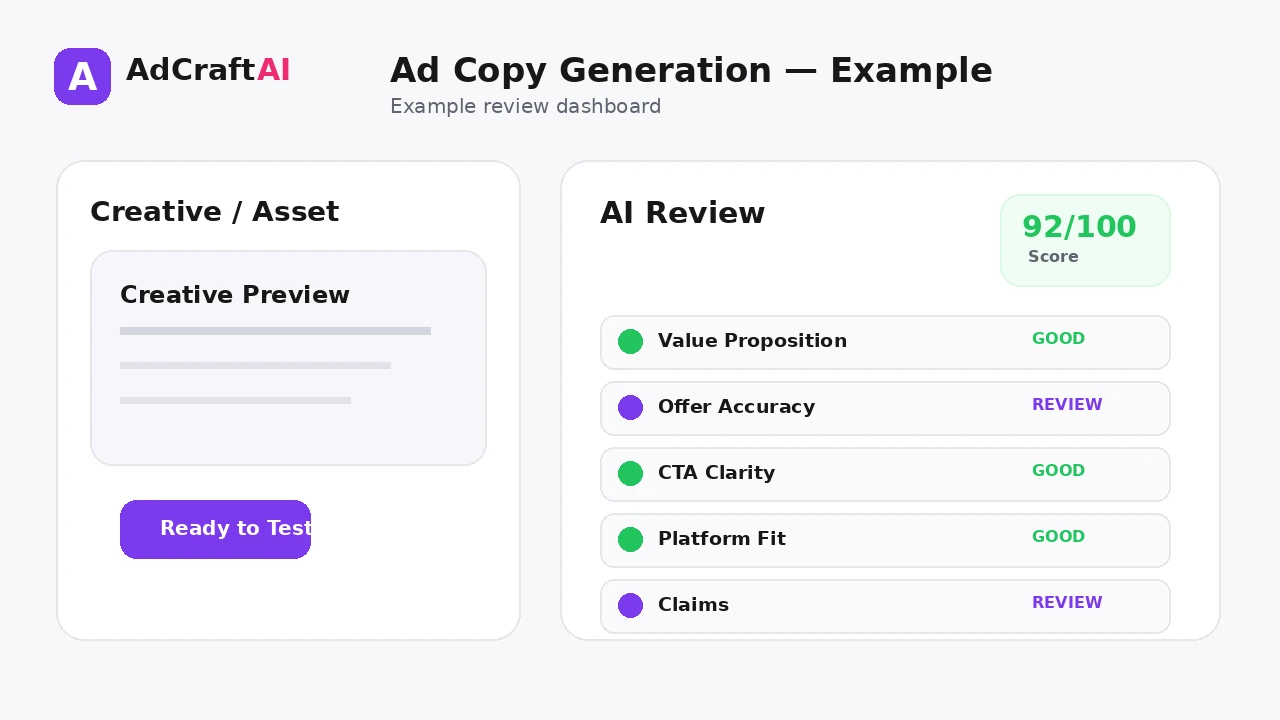
| Review Area | What to Check |
|---|---|
| Value proposition | Does the copy communicate one clear reason to care? |
| Specificity | Are benefits concrete instead of generic? |
| Offer accuracy | Are price and promotional details current? |
| Claims | Can every factual or performance claim be supported? |
| Platform fit | Does the length and tone match the placement? |
| CTA | Is the next action obvious and relevant? |
Review is not a formality. The output becomes useful only when it accurately represents the product, offer, brand and campaign objective.
Practical Example: One Product, Three Copy Angles
Imagine a reusable insulated bottle sold to commuters. Instead of asking AI for “three ads,” give it three distinct hypotheses.
Benefit-led: Lead with temperature retention and everyday convenience.
Problem-solution: Start from warm drinks, leaks or disposable bottle frustration.
Offer-led: Lead with an active promotion, but only when the discount and terms are accurate.
The value of the test is the difference between the messages. Three rewrites of the same sentence usually teach less than three genuinely different angles.
Common Mistakes
Using a vague prompt
Generic input usually produces generic copy.
Generating too many near-duplicates
More variations are only useful when they represent different ideas.
Publishing unsupported claims
AI can create persuasive wording that still requires factual review.
Ignoring the landing page
The ad promise should match what users see after the click.
Using scoring as a guarantee
Prediction can help prioritize, but live results remain the decision source.
Never updating winning copy
Even strong messages can fatigue or lose relevance over time.
Best Practices for Better Results
- Use one clear campaign goal for each generation session.
- Change one important variable at a time so you know what caused a difference.
- Keep source information accurate and current.
- Review AI output against the real product, offer and brand.
- Use prediction or automated checks as decision support, not as guarantees.
- Let live campaign data determine the next creative iteration.
A strong AI workflow is disciplined. It creates more useful options without turning the campaign into uncontrolled content production.
A Simple Repeatable Workflow
- Define the campaign goal.
- Prepare accurate source inputs.
- Generate a small number of meaningful variations.
- Review the strongest outputs for accuracy and brand fit.
- Run any required compliance or commercial-use checks.
- Adapt the creative for the target placement.
- Launch controlled tests.
- Analyze real campaign results.
- Create the next variation from what you learned.
Continue Building Your AI Advertising Workflow
Frequently Asked Questions
Can AI write Facebook and Instagram ad copy?
Yes. AI can draft headlines, primary text and descriptions, but the final copy should be adapted to the specific campaign and reviewed before publishing.
Can AI write Google Ads copy?
Yes. AI can help create headline and description ideas for Google Ads, but final assets still need to fit the campaign format and current platform requirements.
Can AdCreative.ai generate copy from a website?
Its current product page says the ad-copy generator can scan a website URL and extract product details, value propositions and messaging angles.
What are AIDA and PAS?
AIDA structures copy around Attention, Interest, Desire and Action. PAS uses Problem, Agitation and Solution. They are useful frameworks, not guarantees of performance.
Should I use AI-generated ad copy without editing it?
No. Review accuracy, tone, claims, grammar, offer details and platform fit before launch.
How many ad-copy variations should I test?
Start with a small number of meaningfully different hypotheses. The right number depends on your traffic and budget, but clear differences are more useful than many minor rewrites.
Official Resource
Product features can change. Check the current official information before relying on a specific capability in a permanent workflow.
Final Thoughts
Turn a product, offer or website into multiple ad-copy angles, then refine and test the strongest variations.
The best use of AI is not to remove judgment from advertising. It is to reduce repetitive production work, create clearer testing options and make the path from idea to measurable campaign faster.
Build Your Next Creative With AI
Explore AdCreative.ai's generation, analysis and creative-production tools, then review the final assets before putting them into a live campaign.
Discover the AI Tool →